Connect Machines and Equipment
Industrial IoT Platform
See machine data in real time, report faults instantly and keep an eye on your equipment from anywhere. An IoT platform connects controllers, sensors and devices and takes their data where it is needed: Into dashboards, alerts and operator interfaces for manufacturing operations.
In Brief
What is an IoT platform?
An IoT platform is a software environment that connects and networks machines, sensors and devices via interfaces, captures and processes their data in real time and uses this data to enable applications such as monitoring, alerting and remote control.
IoT stands for Internet of Things: Physical objects that exchange data via sensors and software. An IoT platform is the layer between these objects and the people who work with the data. It handles connectivity, data storage, rules and visualization, so companies do not have to build every IoT solution from scratch.
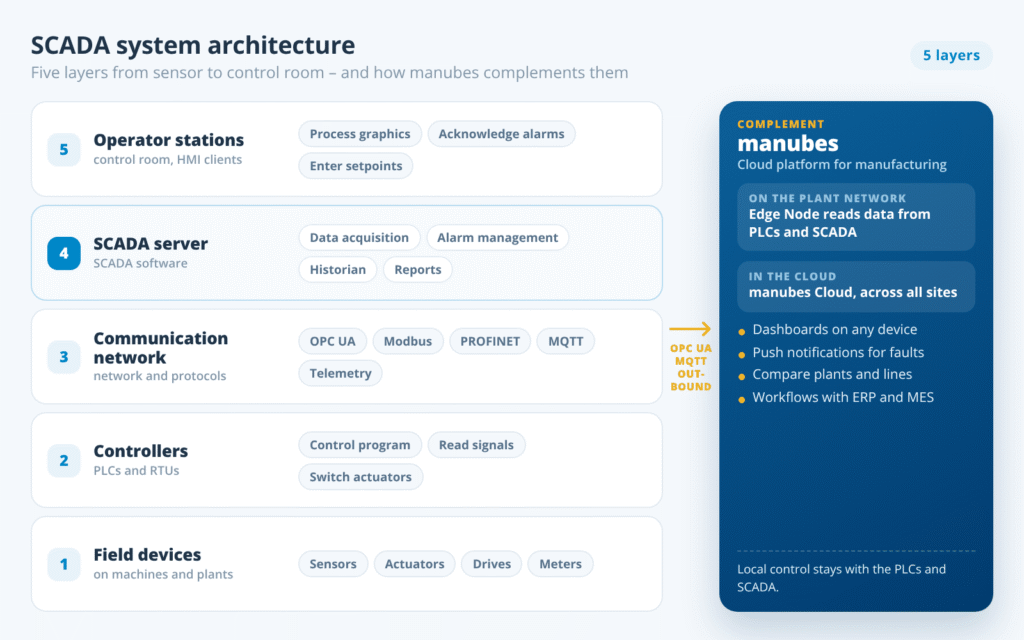
In industry, the term is Industrial Internet of Things (IIoT). An industrial IoT platform, or IIoT platform, connects controllers, machines and measuring equipment via industrial standards such as OPC UA and MQTT. It is designed for high availability, for protecting the production network and for turning machine data into insights for manufacturing.
How It Works
How does an IoT platform work?
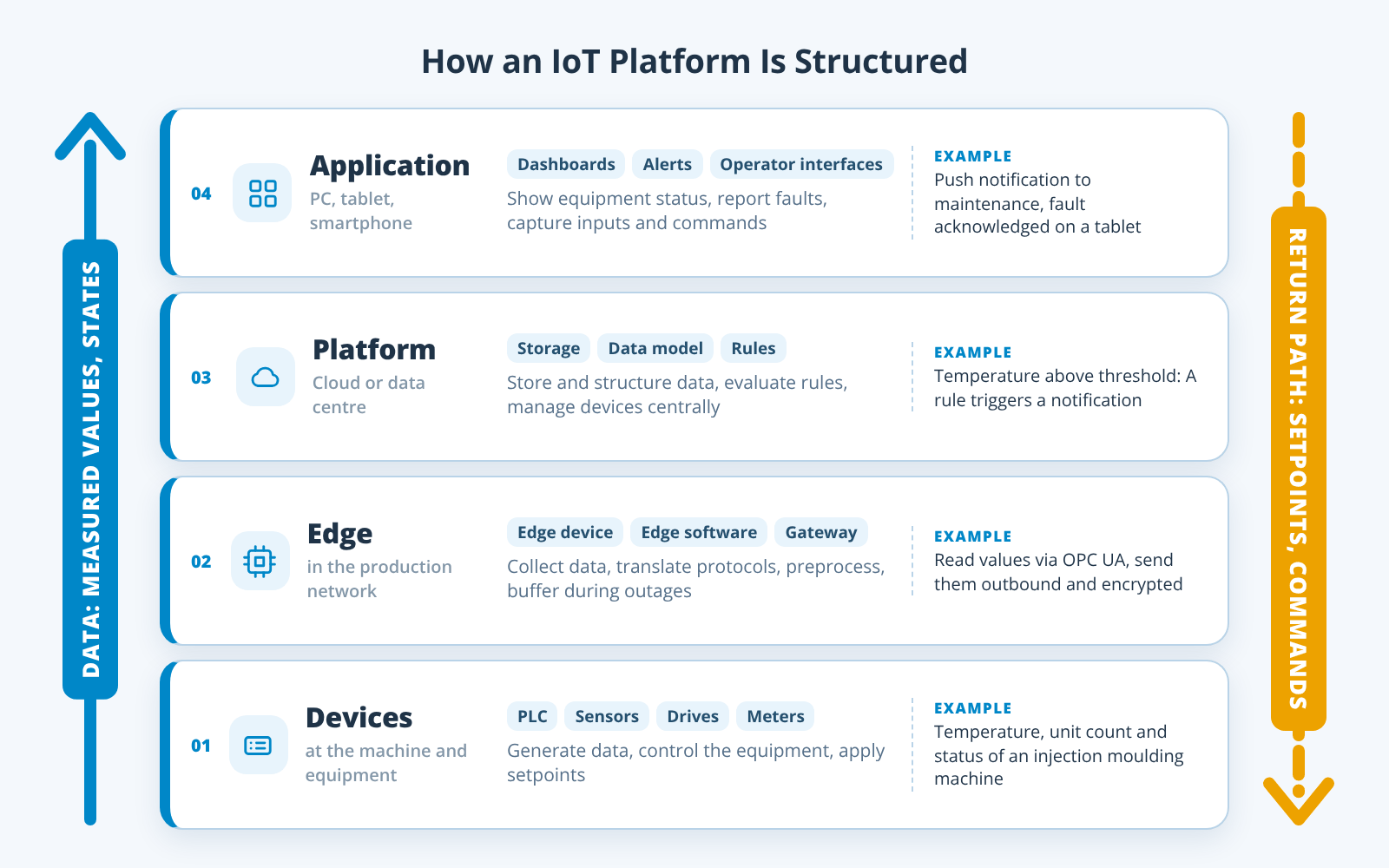
An IoT platform works in four layers: Device, edge, platform and application. Each layer has its own task.
- Devices: Sensors, controllers (PLCs), drives and measuring equipment generate data, such as temperatures, meter readings or machine states.
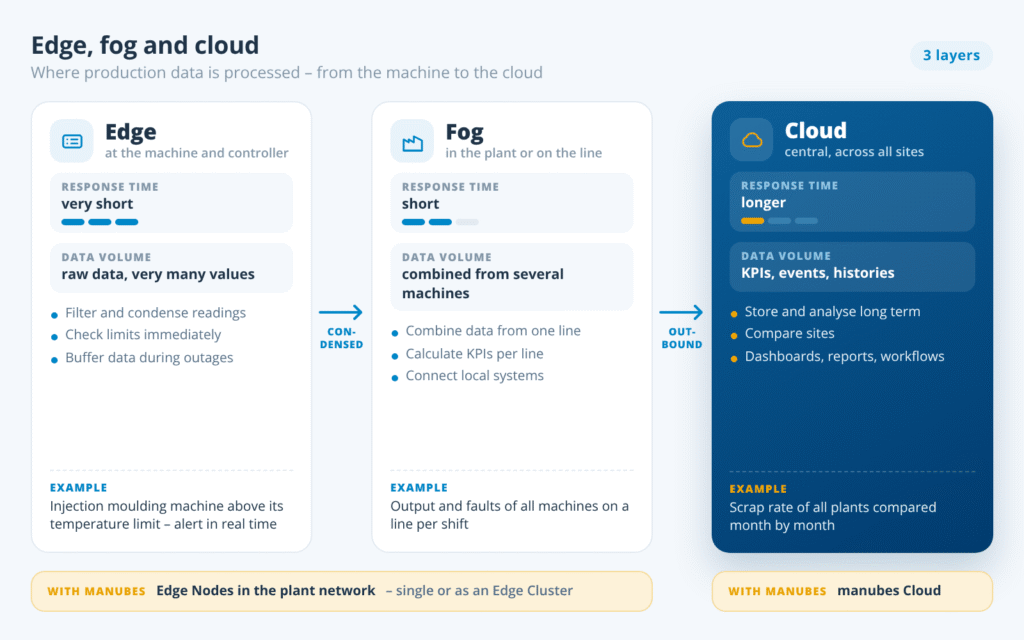
- Edge: A device or piece of software on site collects the data in the production network, translates protocols, preprocesses data and buffers it if the connection drops.
- Platform: In the cloud or a data centre, the data is stored, structured and evaluated by rules and analytics.
- Application: Dashboards, alerts, reports and operator interfaces make the data usable for production, maintenance and management – in the browser, on a tablet or on a smartphone.
Many IoT platforms work in both directions: They not only read values but also send setpoints or commands back to the equipment.
Core Features
What are the components of an IoT platform?
Most IoT platforms combine six core features that companies use to build their IoT solution – from connecting equipment to security.
Connectivity and protocols
Device management
Real-time data capture
Rules and alerts
Visualization and applications
Security
IoT and IIoT
What is the difference between an IoT and an IIoT platform?
An IIoT platform is an IoT platform for industry. The technology is related, but production places much higher demands on availability, interfaces and security.
| Criterion | IoT platform (general) | IIoT platform (industrial) |
|---|---|---|
| Typical devices | Smart home devices, wearables, trackers | Controllers (PLCs), sensors, drives, measuring equipment, entire machines |
| Interfaces | Wi-Fi, Bluetooth, mobile networks, MQTT | OPC UA, REST, MQTT, Modbus; proprietary interfaces and fieldbuses via gateways |
| Availability | An outage is annoying but less likely to have serious consequences | An outage can stop operations; buffering and redundancy are essential |
| Response time | Seconds to minutes are usually enough | Faults must be visible immediately; time-critical control remains in the controller |
| Security | Protection of personal data | In addition, protection of equipment and the production network |
| Device lifetime | A few years | Machines often run for decades; older equipment is connected via gateways or retrofit sensors |
| Users | Consumers, service providers | Production, maintenance, quality, logistics, energy management |
Comparison Table
What types of industrial IoT platforms are there?
Industrial IoT platforms differ mainly in how much development work is needed before the first application runs. In industry, companies usually choose between three types.
| Criterion | Developer platforms from major cloud providers | Industrial no-code IIoT platform | Open-source IoT platform |
|---|---|---|---|
| Examples | Azure IoT Operations (Microsoft), AWS IoT SiteWise (Amazon) | manubes | ThingsBoard |
| Principle | Services for connectivity, asset models and data storage, combined with other services into a custom solution | Ready-to-use platform with connectivity, data model, visualization, workflows and operator interfaces | Open-source software, self-hosted or as a hosted offering |
| Target group | Development teams and solution providers | Departments in production and IT, including users without programming skills | Teams with experience in development and server operations |
| Path to the first application | Plan the architecture, connect services, build interfaces with additional tools or custom development | Connect a data source, create a dashboard by drag and drop | Install, configure, often adapt in code |
| Industrial protocols | OPC UA and others via the provider's edge software | OPC UA, REST, MQTT and databases | MQTT and HTTP directly; OPC UA and Modbus via the ThingsBoard IoT Gateway |
| Operation | Customer is responsible for architecture, edge infrastructure and how services interact | Provider operates the platform; only the edge component runs on site | Customer is responsible for servers, updates and security |
| Costs | Usage-based per service, e.g. by data volume, messages or assets | Based on scalable resources such as users, Edge Nodes, Edge Clusters and data points; workflow actions usage-based | Software free of charge (Community Edition); effort for servers, operation and customization |
Manufacturer information as of October 2026.
manubes
manubes: IIoT Platform for Production Management
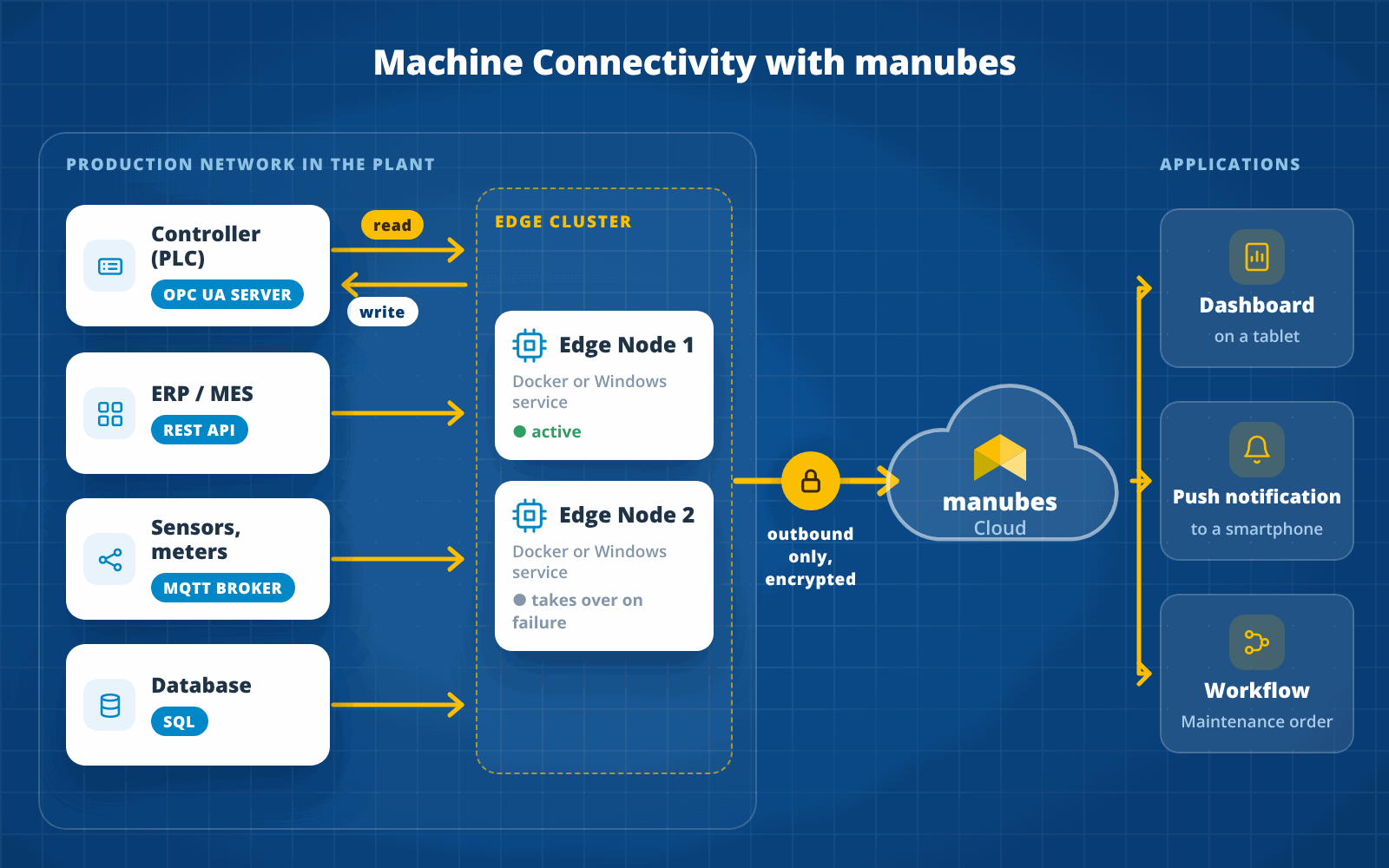
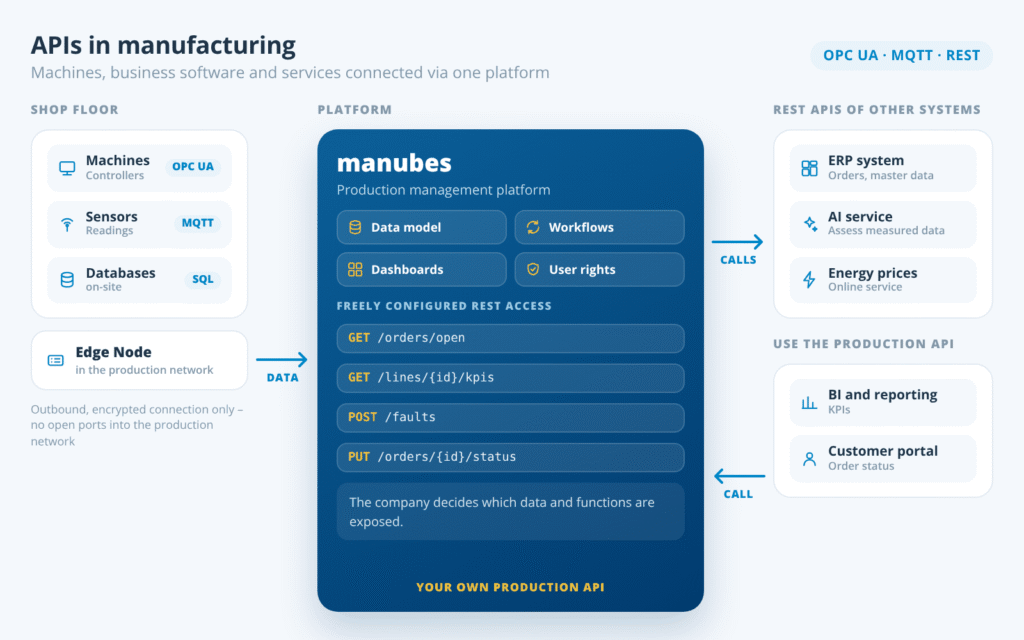
manubes is the industrial IoT platform from inray that manufacturing companies use to connect machines, devices and software systems without programming and to use their data in the cloud for dashboards, alerts, workflows and operator interfaces.
The connection to the equipment is handled by the manubes Edge Node, which runs in the production network as a Docker container or as a Windows service. Using connectors, it reads data from OPC UA servers, REST APIs, MQTT brokers and databases. If required, it also writes setpoints back to controllers, so the connection works in both directions. Because the Edge Node only establishes outbound, encrypted connections, the production network stays closed to inbound connections.
If the connection to the cloud drops, the Edge Node buffers the data until the connection is restored. Several Edge Nodes can be combined into an Edge Cluster, in which another device takes over automatically if one fails. All Edge Nodes are managed centrally in manubes.
manubes is developed by inray Industriesoftware GmbH, a specialist in industrial software for more than 30 years. The pages System integration with manubes and Security concept explain connectivity and security in detail.
Applications
Which IIoT applications can you build with manubes?
With manubes, machine data turns directly into applications for manufacturing operations, maintenance and logistics – created by drag and drop, without programming.
Monitor equipment
Machine states and measured values in real time on dashboards – from the factory floor monitor to the smartphone.
- Machine status
- Floor monitor
Report faults
When a threshold is exceeded, manubes notifies the people responsible by push notification or email.
- Threshold alert
- Fault message
Involve operators
Interactive interfaces for the shop floor and logistics, e.g. to acknowledge faults, record quantities or book material movements.
- Acknowledge fault
- Material booking
Visualize processes
Equipment, stations and material flows as a dynamic process display in which states and values change in real time.
- Equipment display
- Material flow
Capture energy data
Record consumption per machine and period and identify load peaks.
- Consumption per machine
- Load peaks
Analyze OEE
Compare availability, performance and quality of lines and equipment.
- OEE per shift
- Line comparison
Automate processes
Events from the equipment trigger workflows, e.g. a maintenance order or a report.
- Maintenance order
- Shift report
5 Steps to Your First IIoT Application
With manubes, your first application takes just a few steps – from connecting the equipment to the dashboard on your smartphone.
Install the Edge Node
On an industrial PC or edge device in the production network, as a Docker container or Windows service.
Connect a data source
Create a connector for the OPC UA server, REST API or MQTT broker and select the values you need.
Create a dashboard
Link live data directly to a chart by drag and drop – no data model required. For more extensive applications, e.g. with orders, shifts or several sites, data models assign the values to machines and lines.
Set up an alert
Define thresholds and choose who is notified by push notification or email.
Release
Make the application available to the responsible teams – in the browser, on a tablet or smartphone. The step-by-step guide to connecting an edge device shows how this works in practice.
Selection
What should companies look for when choosing an IoT platform?
The right industrial IoT platform is the one that fits your existing machinery, systems and teams. The biggest challenges in IoT projects rarely lie in the software itself, but in diverse equipment, systems and interfaces, security requirements and the effort for operation and customization. For background on the main protocols, see What is OPC UA? and What is MQTT?; for older equipment, see Integrating legacy machines via OPC UA.
Interfaces
Edge and reliability
Write access
Effort to first application
Security
Operation and costs
Try manubes – free and without obligation
Connect your first piece of equipment and create a dashboard – without programming and without your own servers.
Frequently asked questions about IoT platforms
What is an IoT platform?
An IoT platform is a software environment that connects and networks machines, sensors and devices via interfaces, processes their data in real time and uses it to enable applications such as monitoring, alerting and remote control.
What is the difference between IoT and IIoT?
IoT (Internet of Things) refers to connected devices in general, from smart home devices to trackers. IIoT (Industrial Internet of Things) refers to connected machines, controllers and sensors in industry, with higher demands on availability, interfaces and security.
What are the components of an IoT platform?
An IoT platform typically combines connectivity, device management, real-time data capture, rules and alerts, visualization and security. It works across four layers: Devices, edge, platform and application.
What are examples of industrial IoT platforms?
Common examples are developer platforms from major cloud providers such as Azure IoT Operations from Microsoft and AWS IoT SiteWise, open-source platforms such as ThingsBoard and industrial no-code platforms such as manubes. They differ mainly in development and operating effort.
Is there a free IoT platform?
Open-source IoT platforms such as the ThingsBoard Community Edition can be used free of charge. However, servers, updates, security and customization are then your own team's responsibility. manubes can be tested for free.
What is an example of an IoT platform in manufacturing?
One example is manubes: The platform reads data from OPC UA servers, REST APIs and MQTT brokers via an Edge Node, displays it on real-time dashboards and reports faults by push notification.
Does an IoT platform need edge computing?
In industry, almost always. A device or software on site collects data in the production network, translates protocols and buffers data if the connection drops, so no inbound connections into the production network are needed.
Your Equipment on an IIoT Platform
In a product presentation, we show you how manubes connects your machines and which IIoT solutions you can build yourself.
Request a product presentationFurther information