
Explanation & Examples
What is a SCADA System?
A SCADA system is a computer-based architecture that enables the monitoring and control of industrial facilities and processes.
Definition
What is SCADA?
A SCADA system (Supervisory Control and Data Acquisition) is a software-based control system that centrally monitors and controls machines, plants and processes via controllers and sensors and collects their data.
SCADA is short for “Supervisory Control and Data Acquisition” and refers to a system architecture used for monitoring, controlling, and collecting data in industrial processes.
Typically decentralized, SCADA systems consist of a central control unit, known as the SCADA server, and multiple distributed Human Machine Interfaces (HMIs).
A SCADA system communicates with Programmable Logic Controllers and remote terminal units (RTUs) to capture selected data points, trigger alarms if necessary, and provide set values for automated process control.
In the automation pyramid, SCADA sits on the supervisory level: above the PLCs and HMIs on the machine, below MES and ERP. A SCADA system therefore connects the machines on the shop floor with the systems at plant and enterprise level.
Architecture
How is a SCADA system structured?
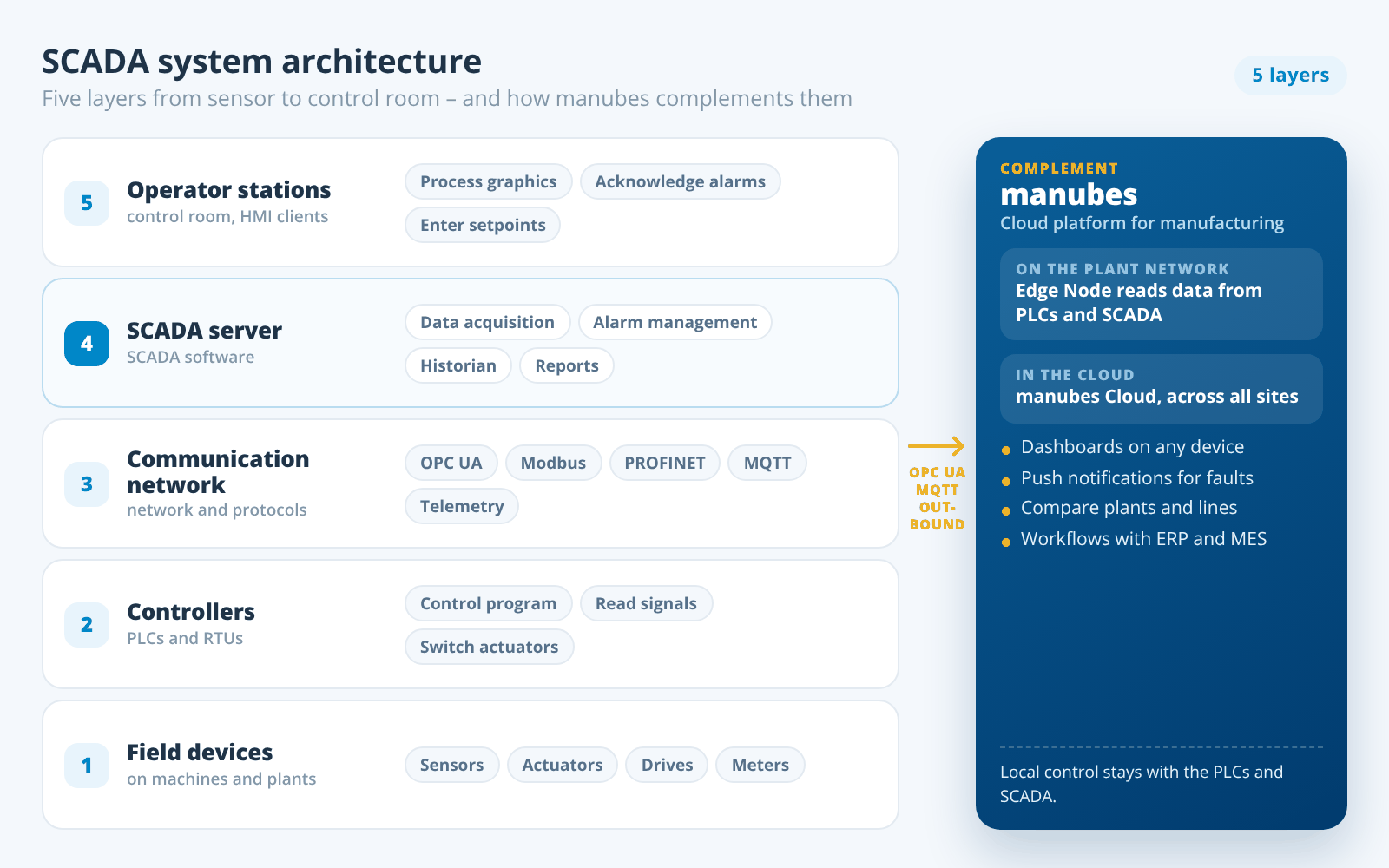
A SCADA system is built in several layers that reach from the sensor on the machine to the operator station in the control room. Hardware and software work together, and the exact architecture depends on the plant and its requirements. Five layers are typical:
- Field devices: sensors, actuators, drives and meters on machines and plants deliver measured values and signals and carry out control commands.
- Controllers: PLCs control machines directly on site. RTUs collect signals from remote or widely distributed parts of a plant and transmit them via telemetry.
- Communication network: a network with industrial protocols such as OPC UA, Modbus, PROFINET or MQTT connects the controllers with the SCADA server.
- SCADA server: the SCADA software acquires the data, manages alarms, stores trends in a historian and creates reports.
- Operator stations: in the control room or on HMI clients, operators see process graphics, acknowledge alarms and enter setpoints.
The diagram also shows how a cloud platform such as manubes complements an existing SCADA system – more on this in the manubes section.
Differentiation
Differences between SCADA and HMI
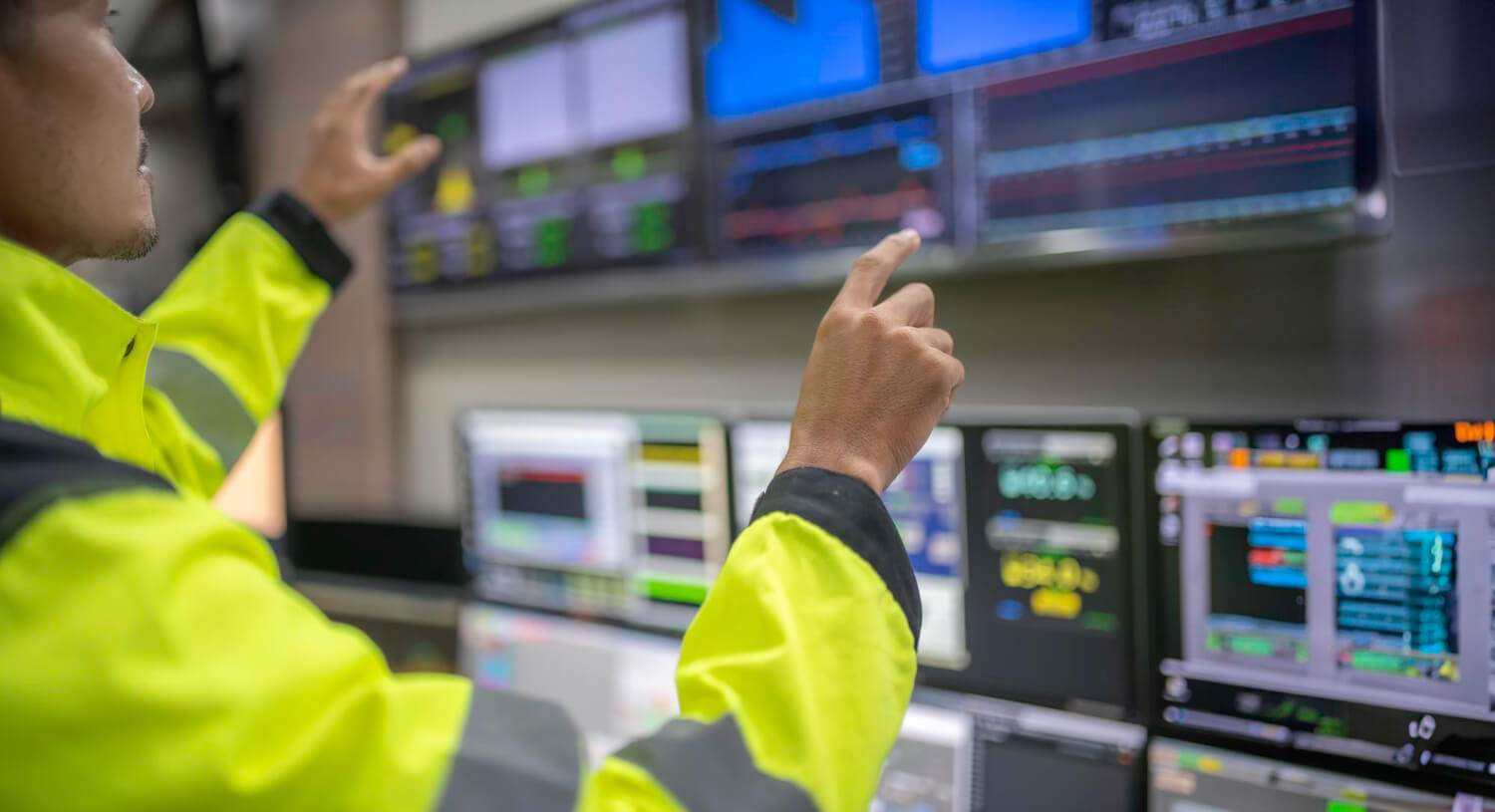
The terms SCADA and HMI are frequently used together, with HMIs serving as essential components within more complex SCADA systems.
- HMIs, or Human Machine Interfaces, serve as the direct user interfaces that allow for visual control of machines and processes.
- SCADA refers to a comprehensive system that collects, stores, and analyzes data from various machines and sensors. It can integrate multiple HMIs, facilitating extensive process management.
In short, operators use an HMI to run one machine, while a SCADA system keeps track of many machines and industrial operations at the same time.
Comparison
SCADA, MES and DCS compared
SCADA systems are often confused with distributed control systems (DCS) and manufacturing execution systems (MES). All three monitor production, but at different points: a DCS controls a process plant, a SCADA system monitors and controls distributed machines and plants, and an MES organizes orders and production processes.
| Criterion | DCS | SCADA | MES |
|---|---|---|---|
| Task | Controls and regulates a process plant end to end | Monitors and controls machines and plants, acquires data and reports alarms | Plans, directs and documents orders and production processes |
| Level of the automation pyramid | Control and supervisory level in one system | Supervisory level | Manufacturing operations level |
| Typical use | One integrated plant, e.g. in chemicals, pharmaceuticals or food production | Several machines, lines or sites, including geographically distributed ones | Production with many orders, variants and traceability |
| Time frame | Milliseconds to seconds, real-time control | Seconds to minutes | Shift, order, day |
| Data | Measured and controlled variables of the plant | Process values, alarms and trends in the historian | Orders, quantities, quality and KPIs such as OEE |
| Users | Plant operators in the control room | Control room staff, shift supervisors, maintenance | Production management, work preparation, quality assurance |
| Connectivity | Its own tightly coupled controllers and field devices | PLCs and RTUs from different vendors via standard protocols | SCADA systems, machines and ERP |
The boundaries are blurring: modern DCS include SCADA functions, and many SCADA systems take on simple MES tasks. How SCADA differs from HMI and PLC is shown in the comparison on the HMI page.
Features
Features of a SCADA system
Complete SCADA systems comprise several components including sensors, controllers such as PLCs, communication networks, and central software for data processing. Their primary functions include:
Data acquisition
Control and automation
Visualization
Alarm management
Reporting and analysis
Industrial Use
Where are SCADA systems used?
SCADA systems are used across a variety of sectors:
- Industrial manufacturing: overseeing production lines and processes
- Energy: managing and monitoring electricity grids and water treatment facilities
- Building automation: automation and control of HVAC systems
- Transport: managing traffic systems and rail operations
- Oil and gas: monitoring pipelines and refineries
SCADA in manufacturing
In manufacturing, a SCADA system monitors machines and lines centrally in real time and makes faults visible immediately. Typical scenarios include:
- monitoring production, filling and packaging lines from a control room and spotting downtime quickly
- recording energy and utilities on site such as electricity, compressed air and cooling water
- controlling HVAC in production halls and clean rooms
- routing fault messages to shift supervisors and maintenance teams
- bringing plants at several sites together centrally via the network
New Developments
Cloud-based SCADA systems
Traditionally, SCADA systems were local and more or less isolated from each other.
However, modern advancements are increasingly moving SCADA to the cloud, unlocking new opportunities:
- Users can access SCADA data globally through web interfaces.
- By leveraging local edge components or gateways, data can be processed on-site and efficiently transported to the cloud (see edge computing).
- Companies can manage collected data centrally for advanced analysis using artificial intelligence and big data techniques.
- Businesses can take advantage of scalable cloud resources, enabling quicker and more cost-effective integration of new facilities or locations.
The four generations of SCADA systems
Experts distinguish four generations of SCADA systems that trace this development:
- Monolithic SCADA systems: a central mainframe handles all tasks, with hardly any connections to other systems.
- Distributed SCADA systems: several computers running SCADA software on a local area network (LAN) share the tasks and exchange data in real time.
- Networked SCADA systems: wide area networks (WAN) and open standard protocols connect geographically distributed plants, which can then be monitored centrally.
- IoT and cloud SCADA: edge devices and cloud platforms complement the classic SCADA system. Data is available across sites, on mobile devices and for AI analysis, while control stays local.
SCADA security
SCADA systems control critical processes and infrastructure, which makes them an attractive target for cyber attacks. They used to run on isolated networks; today they are connected to IT systems, cloud services and remote maintenance access. Good SCADA security therefore depends on the network, protocols, access points and user rights. Four risks – and how companies address them:
Connecting previously isolated plants
Every connection between the production network (OT) and the office network (IT) is a potential attack path. Countermeasure: segment networks, route transitions through firewalls and allow only the connections that are needed.
Older protocols without encryption
Many fieldbus and industrial protocols were designed for closed networks and transmit data unencrypted and without authentication. Countermeasure: where possible, use protocols with encryption and certificates such as OPC UA, and restrict insecure protocols to the local network.
Remote access via open ports
Remote maintenance and remote monitoring often open inbound connections into the production network. Countermeasure: establish outbound connections only. manubes transfers data to the cloud exclusively outbound and encrypted – without any inbound connections into the production network.
Overly broad access rights
Shared accounts and full access for everyone make actions hard to trace and increase the damage of an attack. Countermeasure: personal accounts, roles and rights based on the principle of least privilege, plus regular updates. How manubes protects access and data is described in the security concept.
manubes
manubes as part of a SCADA system
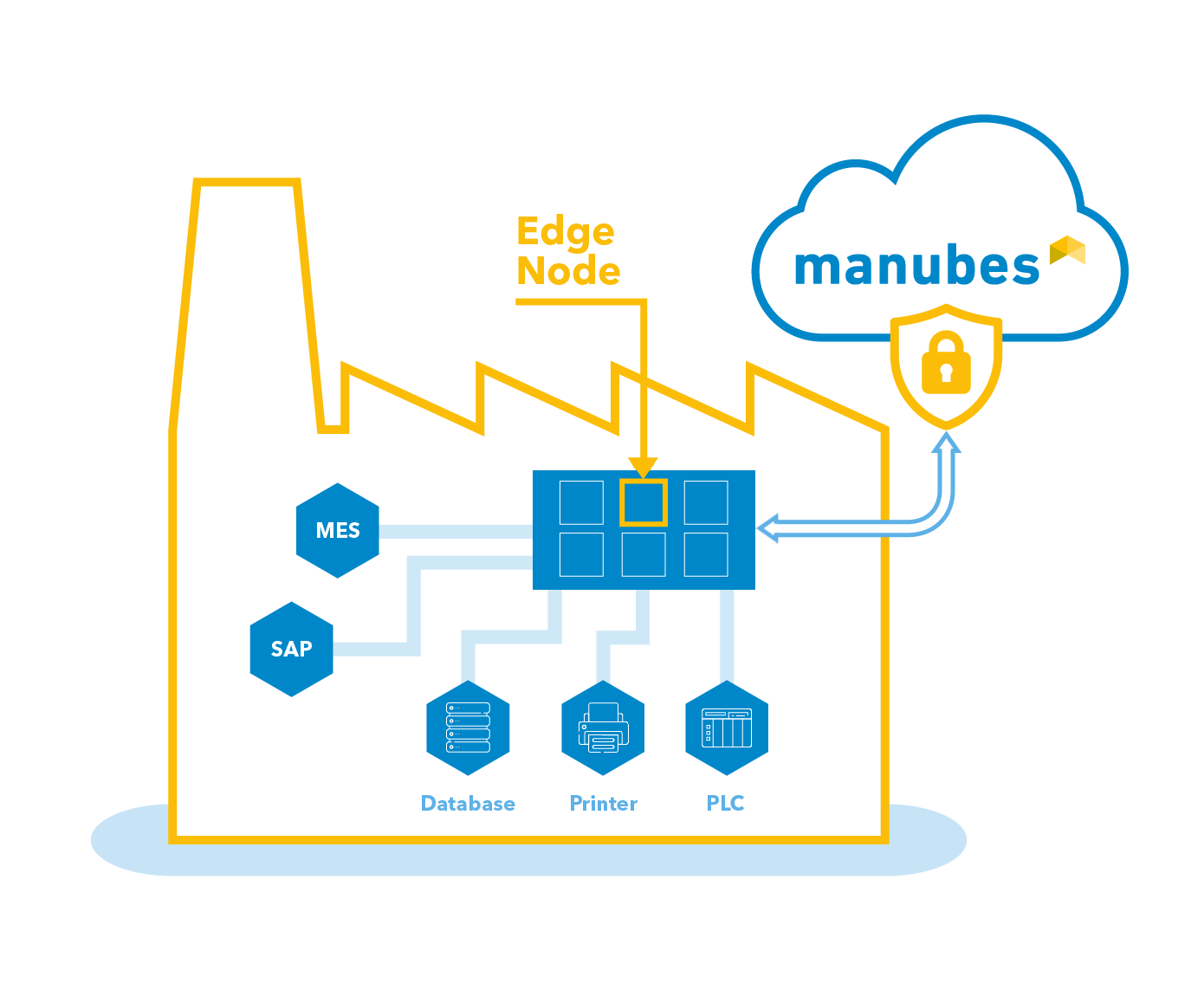
With manubes, companies can capture, visualize and process data from distributed plants and systems within a unified cloud environment, enabling advanced analysis and automation.
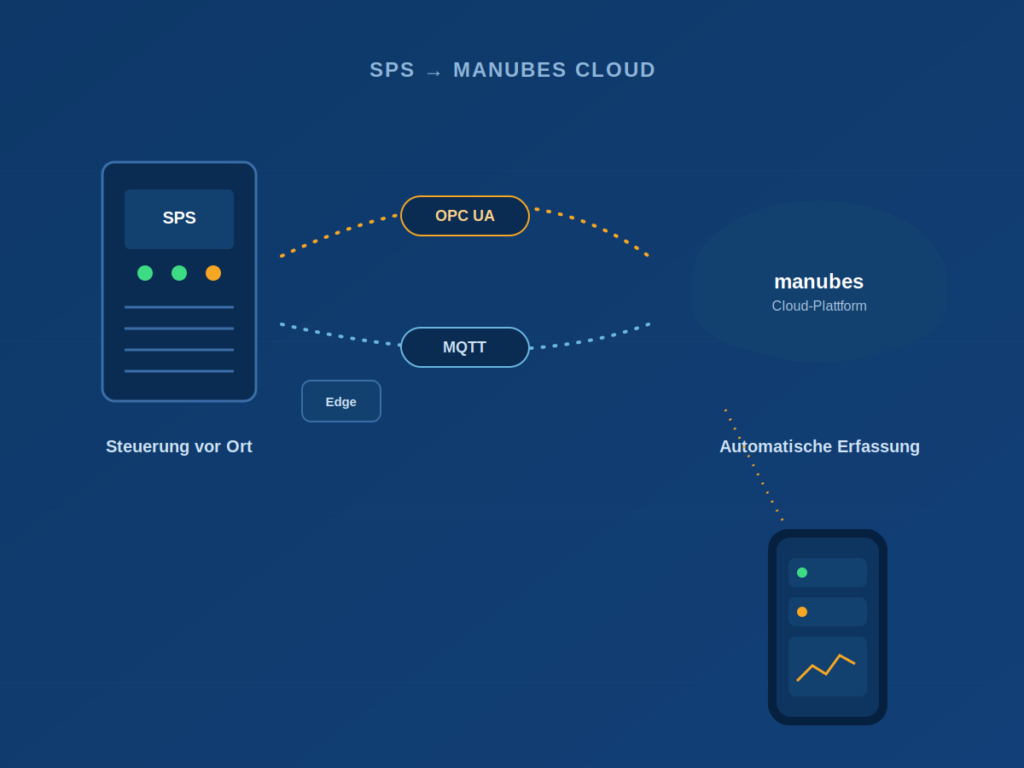
Through local Edge Nodes and standard interfaces like OPC UA, manubes users can directly access automation devices and processes. The connection is bidirectional: manubes reads values from PLCs and SCADA systems and can write setpoints back when needed. The Edge Node pre-processes data on site and buffers it if the connection drops; several Edge Nodes form a fail-safe Edge Cluster.
manubes complements existing SCADA systems with all the advantages of a cloud-based infrastructure, including reduced hardware and licensing costs, mobile accessibility, scalable resources, and collaborative working.
The diagram shows how local production systems are connected to the cloud via the manubes edge components.
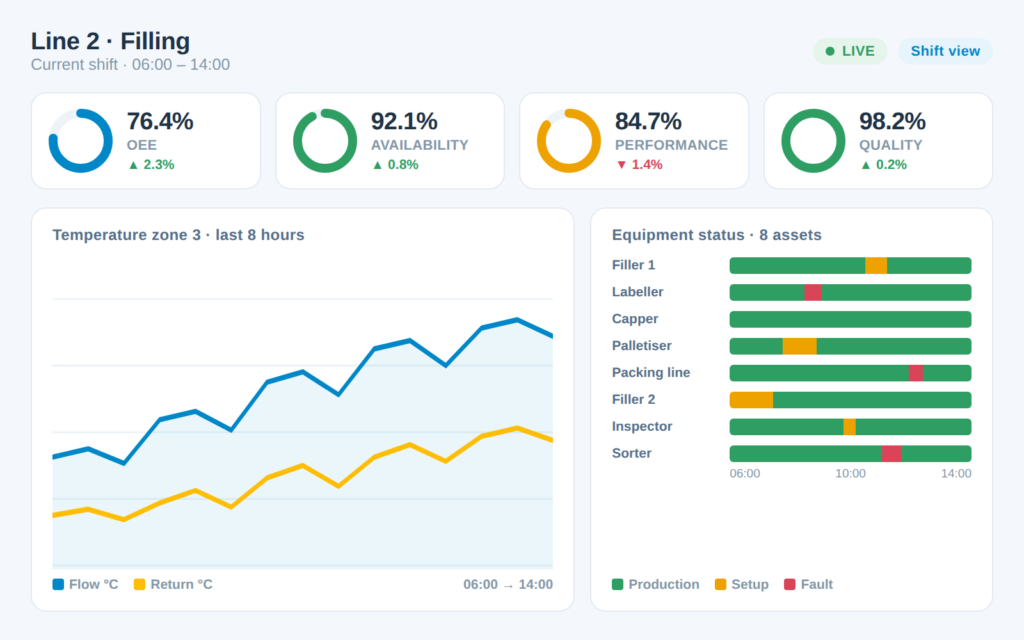
The platform enables real-time visualization of process data through customizable production dashboards that are accessible on any device. Additionally, the AI-powered Chat Assistant provides insights into existing data within seconds, aiding companies in both daily monitoring and long-term optimizations.
With support for common industrial and database interfaces, manubes facilitates targeted connections to existing production systems. As a flexible cloud platform, manubes is designed to complement existing SCADA systems, not to replace them: local control and operation remain with the PLCs, HMIs and SCADA. manubes brings their data together across sites, makes it available on any device and links it to other systems such as MES and ERP through workflows.
Use your SCADA data in the cloud
Connect PLCs and SCADA systems securely via Edge Nodes and visualize production data across all sites – as a complement to your existing SCADA system.
Try manubes for freeConclusion
Technological innovations lead to new opportunities in SCADA
SCADA systems play a crucial role in many industries, fulfilling essential functions in areas like production monitoring and production control. Yet, the specific structure of a SCADA system is not set in stone and typically adapts to existing environments and requirements.
The advancement towards cloud-based systems and AI-enhanced analytics presents new opportunities, enabling companies to process larger volumes of data and scale more rapidly while simplifying data access.
With our cloud platform manubes, manufacturers can expand the functionality of their existing SCADA system and use its data across all sites to improve efficiency.
Frequently asked questions about SCADA systems
What is SCADA and why is it used?
SCADA stands for Supervisory Control and Data Acquisition. A SCADA system centrally monitors and controls industrial equipment, plants and processes in real time, collects their data via PLCs and sensors, reports faults as alarms and stores trends for later analysis. Companies use SCADA to keep track of many machines or distributed sites at once, react to disturbances quickly and optimize their processes based on historical data.
What is the difference between SCADA and HMI?
An HMI is the user interface of a single machine or plant, while a SCADA system is the higher-level system behind it. The HMI shows operators process values on site and accepts their input. The SCADA system collects data from many machines and sensors, stores and analyzes it and can integrate several HMIs.
What is the difference between PLC and SCADA?
A PLC controls a machine, while a SCADA system supervises many controllers. The programmable logic controller runs its program directly on the machine, reads sensors and switches actuators. The SCADA software reads data from several PLCs and RTUs, displays it centrally, reports alarms and provides setpoints. A PLC can therefore run without SCADA – but a SCADA system cannot work without controllers.
What is the difference between SCADA and MES?
SCADA monitors and controls plants, while an MES organizes production. The SCADA system works with process values and alarms within seconds to minutes. A manufacturing execution system plans and documents orders, quantities and quality at shift and order level. The SCADA system often supplies the machine data that the MES evaluates for KPIs such as OEE.
What are the four types of SCADA systems?
The four types of SCADA systems are usually described as generations: monolithic, distributed, networked and IoT or cloud-based SCADA. Monolithic systems ran on a single central computer, distributed systems shared tasks across a local network, and networked systems connected distant sites via wide area networks. IoT and cloud SCADA adds edge devices and cloud platforms, while control stays local.
What is cloud SCADA?
Cloud SCADA moves functions of the SCADA software such as visualization, data storage and analysis to the cloud. Edge devices on the plant network read data from controllers and SCADA systems and transfer it in encrypted form. Time-critical control stays local with the PLCs and SCADA. manubes uses this principle to complement existing systems: Edge Nodes connect the plants, and the manubes Cloud makes their data available across sites.
How secure are SCADA systems?
SCADA systems are as secure as their network and access points. Risks mainly arise from connecting previously isolated plants, unencrypted industrial protocols and open remote access. Proven security measures are segmented networks, encrypted protocols such as OPC UA, outbound-only connections and clearly defined access rights – see the security section for details.
Product video: Get to know manubes
Further information
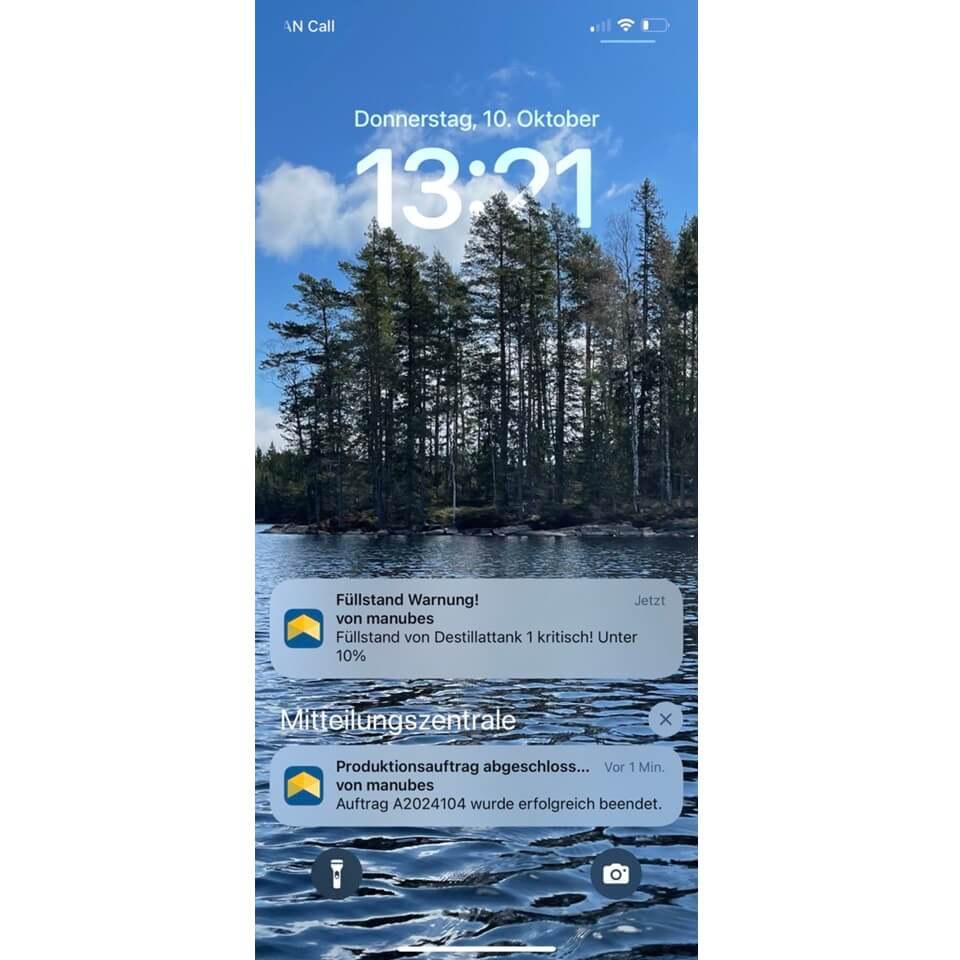
Cloud-based production management with manubes

manubes is a cloud platform specifically tailored to the needs of manufacturers. With manubes, companies of any size are able to rapidly develop future-proof solutions in areas such as production planning, process control and asset monitoring.
Try manubes for free
Test the different manubes features in your personal cloud environment.
Get started
