
OEE Benchmarks across Industries
OEE Benchmarks: Industry Standards and Limitations
Many companies want to compare their equipment performance with industry benchmarks.
We provide OEE benchmarks for various industries, explain the typical sources of loss and show where comparisons reach their limits.
Introduction
OEE Benchmarks – useful or not?
Overall Equipment Effectiveness (OEE) shows how far a piece of equipment operates from its maximum performance. It makes different types of productivity losses measurable and is used across industries to monitor and optimize operations.
The primary purpose of OEE tracking is to support continuous improvement. Ideally, companies measure the performance of a bottleneck asset on a regular basis and optimize it based on a consistent calculation method.
Yet, many companies that track OEE also want to compare their equipment performance against industry benchmarks. While this type of benchmarking is possible, direct comparability of OEE values is often limited.
Manufacturers define and calculate OEE in different ways. Factors like product mix, level of automation, equipment age and many others influence OEE. Even within the same industry, production environments can vary significantly. For this reason, companies should not rely on benchmark values alone, but also focus on typical industry-specific sources of loss and optimization approaches.
Industry-specific Benchmarks
OEE Benchmarks for 5 Example Industries
The often-cited “world-class OEE” of 85% originated in the 1980s in Japan, where it was defined as a target value for production systems. It is heavily influenced by the historical automotive industry and discrete mass manufacturing and therefore cannot be applied across different industries today.
A realistic benchmark always requires considering industry-specific production conditions (and even then there are limitations to keep in mind).
Below, we take a look at five industries:
1. Automotive (OEMs & Tier 1 Suppliers): 75% – 85%

Automotive production relies on highly standardized, robot-assisted, takt-based manufacturing. Typical OEE benchmarks range from 75% to 85%.
Typical sources of loss:
- Planned changeover times due to model changes (availability losses)
- Material shortages caused by complex supply chains (availability losses)
- Ramp-up losses (performance and quality losses)
- Micro-stoppages and disruptions in complex equipment (performance losses)
- Strict quality controls (performance and quality losses)
Conclusion:
The automotive industry operates at a high level of optimization under challenging conditions. Companies must adapt production processes to a high product variety and short product life cycles. Issues within complex supply chains can quickly lead to significant productivity losses.
2. Consumer Goods and Packaging: 70% – 80%

The consumer goods industry (fast-moving consumer goods, FMCG) operates at very high line speeds. OEE values of 70%-80% are a realistic average, but not the upper limit. With long production runs and a high level of automation (e.g. beverage filling), companies can consistently achieve values above 80%.
Typical sources of loss:
- Frequent format and label changes (availability losses)
- Micro-stoppages caused by jammed materials or sensor errors (performance losses)
- Material quality issues (performance and quality losses)
Conclusion:
The consumer goods industry relies on high-speed lines. As a result, short interruptions that reduce the target line speed often represent the biggest source of loss.
3. Pharmaceutical Industry and Medical Technology: 60% – 70%

The pharmaceutical industry is typically highly regulated. Meeting compliance and product quality requirements takes priority over output volume. Typical OEE benchmarks range between 60% and 70%. However, continuous processes and more stable lines can also achieve values above 75%.
Typical sources of loss:
- Frequent and thorough cleaning procedures (availability losses)
- Line clearance between batches, including visual inspection, release and documentation (availability losses)
- Changeovers and format changes with small batch sizes (availability losses)
- Strict quality controls (quality losses)
Conclusion:
In the pharmaceutical and medical technology industries, the greatest improvement potential typically lies in availability. With effective organization (e.g. preparing clearance processes during ongoing operations), companies can reduce time losses caused by compliance requirements.
4. Mechanical Engineering: 60% – 70%
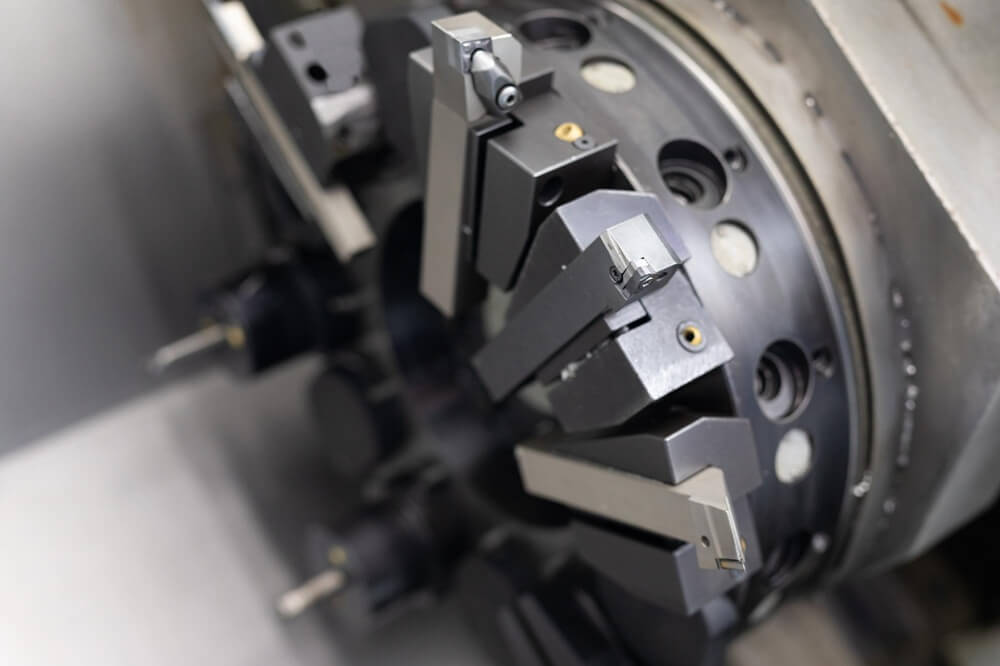
Mechanical engineering is typically characterized by high product variety, frequent changeovers and a relatively high level of manual intervention. Processes are often more customer-specific and less standardized than in industries such as automotive or consumer goods. Typical OEE benchmarks range between 60% and 70%.
Typical sources of loss:
- Frequent changeovers due to varying components or programs (availability losses)
- Waiting for parts and upstream processes (availability losses)
- Individual machine setup and fine-tuning (availability losses)
- Operator dependency in complex processes (performance losses)
Conclusion:
Many mechanical engineering companies operate in job production or high-mix manufacturing. As a result, OEE benchmarks are generally lower than in high-volume production (e.g. consumer goods). In addition, the industry is less standardized than the automotive sector.
However, mechanical engineering is not a homogeneous field: Manufacturers with serial production (e.g. component suppliers) typically achieve higher average values than companies focused on one-off production (e.g. special-purpose machinery).
5. Chemical Industry: 75% – 85%

The chemical industry has structural advantages over many discrete manufacturing sectors (see also discrete vs. process manufacturing), including continuous processes (24/7 operations), less frequent product changes and a high level of automation. Typical OEE benchmarks range from 75% to 85%.
Typical sources of loss:
- Long planned shutdowns for turnarounds and overhauls (availability losses)
- Complex cleaning processes (availability losses)
- Lengthy start-up and shutdown procedures (availability losses)
- Age-related equipment wear (performance losses)
- Start-up losses and process instability (quality losses)
Conclusion:
Short unplanned stops and disruptions are less common in the chemical industry than in other sectors. However, planned downtime for maintenance, inspections and cleaning often lasts significantly longer.
Limitations
Limitations of OEE Benchmarks
Focusing solely on external OEE benchmarks is rarely effective and involves risks that companies need to consider:
Different calculation methods:
Companies define losses differently. Does planned preventive maintenance count as scheduled downtime that is excluded from OEE, or does it reduce availability? Are break times excluded?
Economic distortion:
Optimizing OEE blindly is not necessarily economically beneficial. A fully depreciated 20-year-old machine with an OEE of 60% may be more profitable than a capital-intensive asset with 85% OEE.
Conflict with other objectives:
Larger batch sizes reduce changeover times and improve OEE, but they can lead to overproduction and excessive inventory.
Focus on the wrong assets:
If a machine is not a bottleneck, improving its OEE may deliver no real benefit.
OEE should primarily serve as a tool for the Continuous Improvement Process (CIP) and be applied specifically to bottleneck assets within the company. External OEE data is most useful when it provides detailed insights into sources of loss and the impact of optimization measures.
Try manubes for free
Test the different manubes features in your personal cloud environment.

